Table of Contents
- Start With the Wood Species and Dimensions
- Edge Profiles, Thickness, and Finish Options
- Custom Restaurant Menu Holders and Handcrafted Wooden Check Presenters
- Bulk Ordering Custom Hardwood Accessories Across Multiple Locations
- Wood Movement, Weight, and Structural Support
- Cost, Lead Times, and Freight Shipping
- Installing Your Tabletop and Keeping It Service-Ready
- Conclusion
- Frequently Asked Questions
Last Updated: September 23, 2026
Start With the Wood Species and Dimensions
Ordering custom wooden tabletop goods online starts with two decisions that lock in everything else: species and exact size. Get those wrong and no edge profile or finish will rescue the result. At HOSPITALITY HARDWOODS, we have milled solid hardwood tabletop accessories since 2014, and the smoothest orders are the ones where the buyer measured first and chose the wood second.
Walnut, Oak, Maple, and Cherry Compared
Each species behaves differently in daily service, color, grain, and how it ages under spills and handling.
| Species | Color and Grain | Best For | Notes |
|---|---|---|---|
| Walnut | Dark brown, flowing grain | Fine dining, check presenters | Hides handling marks well |
| Oak | Light to medium, pronounced grain | High-volume bars, tabletops | Very hard, takes stain evenly |
| Maple | Pale, fine, subtle grain | Cafés, menu holders | Shows stains more readily |
| Cherry | Warm red-brown, darkens over time | Boutique hotels, resorts | Color deepens with age |
How to Measure Your Table Before You Order
Measure the table's actual surface, not the room or the base. Record length and width at the widest point, note any overhang beyond the base, and for a replacement top measure edge to edge and confirm the thickness you are replacing.
- Measure length and width to the nearest 1/8 inch at the widest point
- Note the existing thickness and whether the base supports a thicker top
- Photograph the table base and any mounting points
- Check clearance for chairs and walkways after the new top is placed
- Confirm the measurement twice, on different days if possible
Edge Profiles, Thickness, and Finish Options
Edge profile and thickness determine how a piece feels in the hand; finish determines how it survives service. A square edge reads crisp and modern; a round edge softens contact points and reduces corner chipping. A 1-inch top feels substantial on a dining table, while a 3/4-inch top suits a menu holder or check presenter.
Butcher Block vs. Solid Plank vs. Live Edge
For restaurant work, butcher block and solid plank are the practical choices because they are predictable and easy to mount. Live edge belongs where irregular character is the point, such as a feature table or craft brewery bar top.
Custom Restaurant Menu Holders and Handcrafted Wooden Check Presenters
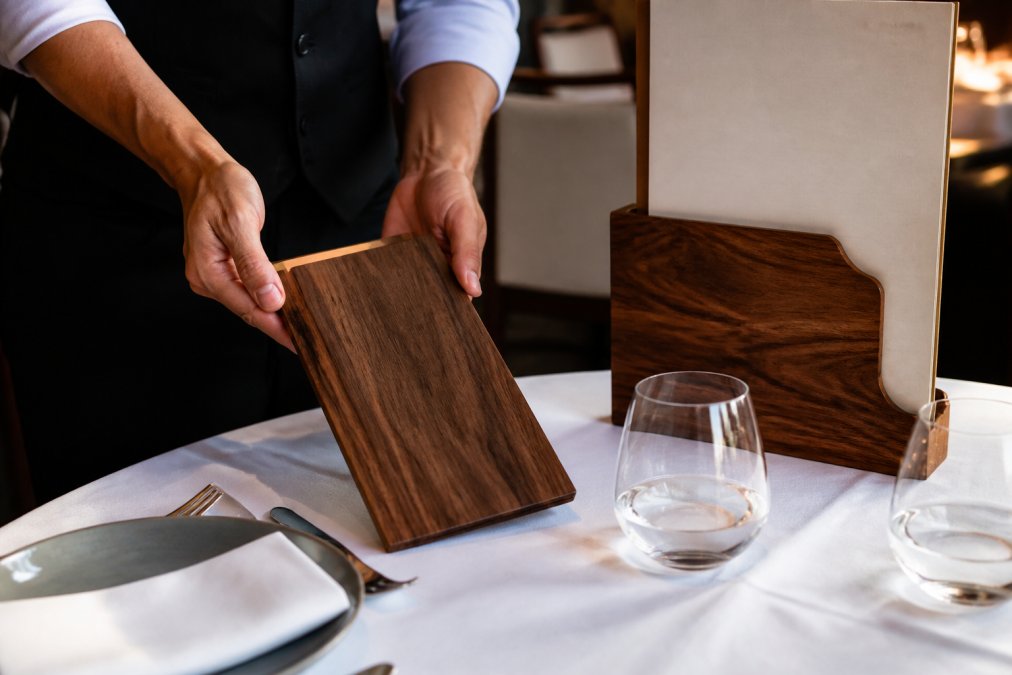
Custom restaurant menu holders and handcrafted wooden check presenters carry your brand from first interaction to last: a menu holder sets the tone before a guest orders, and a check presenter is the final object they touch before leaving. Both are handled dozens of times a day, which is why wood and finish matter more here than anywhere else on the table.
Bulk Ordering Custom Hardwood Accessories Across Multiple Locations
Bulk ordering custom hardwood accessories across multiple locations is a consistency problem before it is a volume problem. Five venues ordering separately produce five slightly different results, because wood is a natural material and every milled run varies. The fix: one order or coordinated program specifying a single species, finish level, and engraving file for every location.
- Consolidate all locations into one specification sheet before ordering
- Lock the species, thickness, edge profile, and finish in writing
- Approve a single physical sample that becomes the reference for the whole run
- Sequence delivery by opening date rather than ordering site by site
- Keep a spare set at each venue for replacement tops and breakage
Wood Movement, Weight, and Structural Support
Wood moves. Even kiln-dried hardwood expands and contracts as indoor humidity shifts through the year, and a tabletop fastened rigidly to its base will fight that movement until it cracks or cups.
Cost, Lead Times, and Freight Shipping
Pricing for made-to-order hardwood goods depends on species, dimensions, thickness, finish level, engraving, and quantity, so no single figure applies across the board. Cost scales with the wood and the work to finish it; the way to get a real number is a custom quote based on your specifications.
Installing Your Tabletop and Keeping It Service-Ready
Most sellers stop at the sale. The step buyers actually struggle with is attaching a heavy custom top to an existing base without cracking it, where a little knowledge separates a top that lasts decades from one that cups within a year. Here is the mounting method, the hardware that makes it work, and the care routine that keeps the finish service-ready.
Why You Cannot Screw a Solid Top Directly to a Base
The fix is a mounting system that holds the top flat while letting it slide. The most common approach is a figure-eight fastener (tabletop clip): one loop screws to the base rail, the other to the underside of the top, and as the wood moves the fastener rotates slightly instead of fighting it. Z-clips and slotted brackets do the same job on larger tops.
A Step-by-Step Mounting Sequence
- Confirm the base is level and square. A twisted base will telegraph into the top. Shim or adjust before you set anything down.
- Lay the top face-down on a padded surface, a moving blanket or cardboard, so you can work on the underside without scratching the finish.
- Position the base on the underside and mark where the rails meet the top.
- Attach figure-eight fasteners to the base rails, spacing them roughly every 12 to 18 inches along each rail and within a few inches of the corners.
- Drive the top-side screws into the underside only, never through the top surface. Pre-drill to avoid splitting.
- Flip the assembly upright with a helper. A thick hardwood top is heavy; do not attempt this alone.
- Check for flatness with a straightedge across the surface and along the diagonal. If it rocks, the base is the culprit, not the top.
Matching the Base to the Weight of the Top
Weight is the second factor buyers underestimate. A thick solid hardwood top is heavy, and the base must carry it without flexing. Confirm the base's load capacity and support points before ordering. Keep unsupported overhang modest and add a center support leg or stretcher on long spans.
Day-to-Day Care by Finish Type
Across all finishes: do not leave standing water on the surface, use coasters under hot items, and touch up small marks before they become visible wear.
Conclusion
The gap between a custom order that delights you and one that disappoints comes down to details you settle before you buy: species, dimensions, edge profile, finish, and how the piece will be mounted and maintained. Hospitality Hardwoods builds made-to-order solid hardwood tabletop goods, including logo-engraved check presenters and menu holders, in walnut, oak, maple, and cherry, proudly made in the USA and manufactured since 2014.
Frequently Asked Questions
What should I look for when ordering custom wooden goods online for my business?
Check four things before you commit: the species and whether it is solid hardwood or a veneer, the moisture content and kiln-drying method, the finish and edge profile you are specifying, and the lead time in writing.
How long does it typically take to manufacture custom wooden restaurant supplies?
Lead time depends on order size, engraving complexity, and current production queue. Simple items like check presenters usually move faster than large tabletops, which need milling, glue-up, sanding, and finishing time. If you have a rebranding deadline, share the date when you request a quote so the maker can confirm whether it is realistic. Freight shipping adds transit days on top of production, so build a buffer into your schedule.
What are the benefits of using solid hardwood for restaurant tabletop accessories?
Solid hardwood takes engraving cleanly, so your logo reads sharply and stays legible. It resists the daily wear of high-volume service better than laminate or veneer, and it can be sanded and refinished instead of replaced. Walnut, oak, maple, and cherry each bring a different grain and tone, which lets you match the room's design. A replacement top or a refinish extends the life of a piece you already own.
Can custom wooden tabletop goods improve my restaurant's brand identity?
Yes, because guests handle these items directly. A menu holder and a check presenter are the first and last physical objects a guest touches, so a consistent wood species, finish, and engraved logo ties the experience together. For multi-location groups, ordering the same spec across every venue keeps that identity identical.
What is the difference between mass-produced and handcrafted wooden tabletop items?
Mass-produced items are cut to one fixed size and finish, often from laminate or veneer, and they are replaced rather than repaired. Handcrafted pieces are milled to your dimensions, sanded and finished by hand, and can be engraved with your logo. The trade-off is lead time and cost.
Will a wooden tabletop warp or stain in a busy bar?
Wood moves with humidity, so any solid top will expand and contract slightly across the seasons. Kiln-dried lumber and a proper finish reduce that movement, and mounting hardware that allows the top to shift prevents cracking. Spills are the bigger day-to-day risk, so wipe them promptly and avoid leaving standing water.